Cavendish Cards come from the Cavendish Space model, which sits inside a larger Stimpunks method: ARLES. ARLES is how we decide what to change, and in what order — so the work lands on the environment instead of on a person.
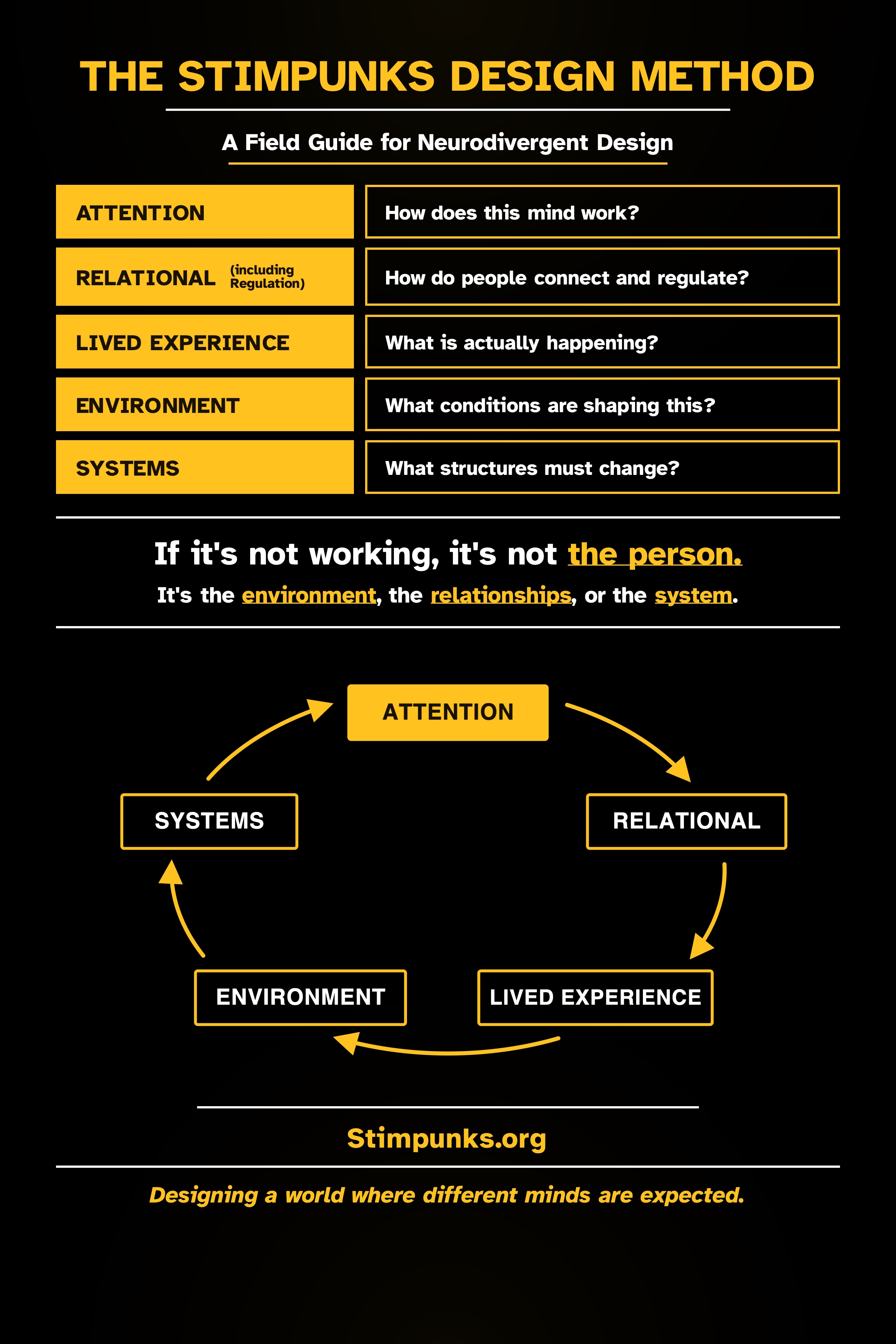
What ARLES is
ARLES is the Stimpunks Design Method. It names the five layers through which neurodivergent life is structured, and the order in which environments should be redesigned to support it:
Attention → Relational (including Regulation) → Lived Experience → Environment → Systems.
It is a ladder, not a checklist. You can read it two ways: upward to design, downward to diagnose. It starts at the bottom, where a person actually is — how a mind attends and regulates — and works outward to the environment and the systems around it. Most reform skips to the top, rewrites a policy, and asks people to cope. ARLES refuses that order. If it isn't working, it isn't the person — it's the attention, the relationships, the environment, or the system. Broken systems, not broken people.
Where the cards sit
The deck is ARLES made handheld. A spread reads the ladder from the bottom up: it starts where a person is, and turns that into changes to the room. The cards live across the lower and middle layers, and stop short of Systems as cards — because the deck hands a person a design brief, never a policy.
- Attention — the monotropism and flow cards: in the zone, pulled every way, let me finish, foggy, i want to stay a while. How a mind attends, and what it costs to be pulled across.
- Relational (incl. Regulation) — the Interaction badges, the Kind words, the Lily pads, and co-regulation weather like meerkat and stormy. Connection, consent, and the safety to regulate.
- Lived Experience — the whole Weather realm. Naming what is actually happening inside, in the person's own frame.
- Environment — Places, What helps, and the Growers. The conditions you can change: the room, the niche, the fit.
- Systems — no cards, on purpose. The one nod to it is the blank card — Systems as method: the community changing the deck itself.
Why it stops short of Systems
Systems change is real, and necessary — but it is not something to ask a person to name on a card. The deck's job is to move the work off the person and onto the environment, on the person's own terms. A spread is a design brief for the room and the people in it, not a policy handed down. The Systems layer is where the Stimpunks Pattern Library and the deck's own Pattern crosswalk carry the work forward — from a named need, to a pattern, to a change in the structures around it.
SLODF, and the layer the deck supplies
The System-Level Organisational Design Framework (SLODF; Dark, 2026) is a workplace-inclusion framework that reads across four organisational domains — environment, systems, people, and policy — and moves the work of inclusion off the individual and onto organisational design. It shares the deck's premise word for word: if it isn't working, it's not the person — it's the environment, the relationships, or the system.
Read against ARLES, SLODF's four domains fill the top of the ladder. Environment maps straight across; systems and policy sit in the structural rungs above; people carries the relational work. Where ARLES reads down — from Systems to Environment to Lived Experience to Relational to Attention — SLODF reads across the top three rungs and translates them into a workplace an organisation can act on. But it stops there. SLODF has no Lived Experience layer — no separate account of what the day actually feels like, held apart from the systems that shape it. That layer is the whole Weather realm.
So the deck isn't something to bolt onto SLODF; it's the piece SLODF is missing. A spread laid at work (see example spread 9, A new job, first weeks) is the Lived Experience layer feeding an organisational redesign: the person names what the day feels like from the inside, and a framework like SLODF turns that into changes across environment, systems, and people. One reads down to where the person actually is; the other reads across to what the organisation can change. The ARLES crosswalk reads the two side by side.
EMD, and reading a spread as feedback
The Ecosystemic Model of Distress (EMD; Gray-Hammond) is a companion crosswalk to SLODF, but it does a different job. Where SLODF is a catalogue of what an organisation can do, EMD is a model of how distress moves — through nested ecosystems, from the bodymind outward to sensory and relational conditions and up to systems, power, and access. It shares the deck's stance completely: distress isn't located in the person, the environment is never neutral (it fits or fights), and regulation is relational and environmental, not a skill a person is failing to practise.
Read against ARLES, EMD folds the ladder into a current. It bundles the experiential interior — Attention and Lived Experience — into one bodymind, folds Relational and Environment into one immediate ecosystem, and shares the systems layer outright. As the crosswalk puts it: EMD tells you how distress flows through the layers; ARLES tells you the order to build them back. One reads the ecology as a current, the other as a ladder — the model finds where the water is rising, the method finds where to start laying floor.
The deck sits at the bodymind end of that current, and it changes how a spread is read. A spread isn't a symptom list; it is feedback — the sign that something in the ecosystem is unsustainable, surfaced in the person's own frame and on the person's own terms. Stormy, running on empty, meerkat, can't tell are not faults to fix in the person; they are the bodymind reporting a mismatch, so you can trace it outward to the condition that's rising and change that. This is why the deck cards the felt states but not the systems: EMD's power, access, and institutional layers are real and central, but they are not something to ask a person to name on a card. The person names where it hurts; the Pattern Library and frameworks like EMD and SLODF carry the work up the layers from there.
Go deeper
- ARLES — the Stimpunks Design Method — the full definition, and the ladder read both ways.
- The Neurodivergent Design Field Guide — ARLES as a practice loop you can run.
- The Stimpunks Pattern Library — the patterns each card instantiates.
- The SLODF ARLES crosswalk — the deck as the Lived Experience layer a workplace-inclusion framework lacks.
- The EMD ARLES crosswalk — distress as a current through nested ecosystems; a spread read as feedback, not symptom.
- Why this exists and Origin & lineage — how the deck grew out of Cavendish Space.